
The mythic 1-mile wave Duke Kahanamoku, a five-time Olympic medalist in swimming, used his global fame to share the sport of he’e nalu (wave sliding) with the world.
But his most legendary feat happened right at home in Waikiki.
In 1917, riding a massive, 16-foot surfboard hand-carved from solid koa wood that weighed 114 pounds, Duke caught a monster swell at an outer reef break called Castle’s.
He connected it through multiple surf lineups, speeding past the Moana Hotel and finally stepping off his board right onto the sand at Kahanamoku Beach.
The ride spanned a mind-boggling 1.125 miles, a distance that remains historically unbeatable.
Waikiki’s famous Beach Boys were much more than surf instructors
The “Waikiki Beach Boys” were legendary watermen who taught visitors to surf, steered outrigger canoes, rescued swimmers, and served as cultural ambassadors.
Many tourists thought they were simply surf instructors.
In reality, they preserved Hawaiian ocean knowledge through decades of rapid tourism development. And they were highly sociable with the haoles, both men and women.
The nicknames of the original Beach Boys
The original Waikiki Beach Boys of the early 1900s were such distinct personalities that they rarely went by their legal names.
If you walked down the beach in 1930, you wouldn’t ask for George or William. You would look for guys named: Steamboat, Turkey, Splash, Colgate (named for his bright, white-toothed smile), Scooter, Panama, etc.
These men were so respected for their ocean safety skills that they eventually transformed from a loose group of local surfers into the Territorial Beach Patrol, laying the foundation for Hawaii’s modern professional ocean rescue lifeguards (Honolulu Ocean Safety Department).
Teaching Hollywood royalty (and British royalty) to surf
Because of Waikiki’s status as a luxury playground in the 1920s and 1930s, the Beach Boys became the personal instructors to the world’s most famous elite.
Duke Kahanamoku personally taught Edward, Prince of Wales (the future King of England) how to surf during a royal visit in 1920.
Legendary Beach Boys like Louis “Steamboat” Mokuahi and Chick Daniels gave private lessons to Hollywood icons like Shirley Temple, Buster Keaton, Douglas Fairbanks, and Amelia Earhart.
You can surf Waikiki in a giant canoe
One of the most unique Waikiki experiences isn’t a surfboard at all.
Large outrigger canoes regularly catch and ride Waikiki’s rolling waves.
The tradition dates back more than a century and remains a major part of local water culture. Seeing six or more people surfing the same wave in a canoe is still common.
The most crowded lineup in Hawaii may also be one of the friendliest
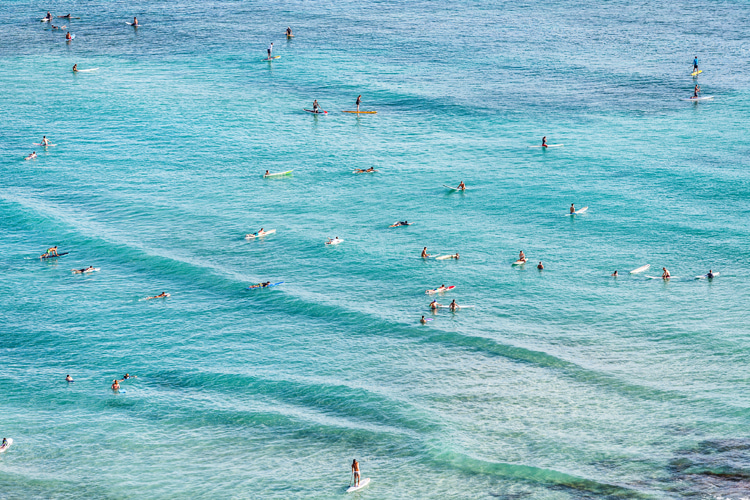
At breaks like Queens and Canoes, dozens – or sometimes hundreds – of surfers can share the same area.
Yet the mellow nature of the waves encourages a social atmosphere unlike the more competitive lineups found at famous big-wave spots.
Just make sure to respect everyone.
Waikiki’s waves are why beginners around the world stand up on their first day
Many surf schools choose Waikiki because the reef creates long, predictable rides.
A wave here can carry a novice surfer much farther than many beach-break waves elsewhere in the world.
That’s why countless visitors catch their first wave in Waikiki.
Waikiki: tourism is a fundamental piece of Honolulu’s famous neighborhood | Photo: Shutterstock
Some of Waikiki’s sand came from California
One of the strangest Waikiki facts has little or nothing to do with surfing itself.
The pristine, continuous sandy beach you see today in Waikiki is an illusion. It is largely a massive, multi-decade civil engineering project.
Historically, Waikiki (which translates to “spouting fresh water”) was a vast wetland composed of taro fields, fishponds, and meandering streams backed by coconut groves.
In the 1920s, the construction of the Ala Wai Canal drained and diverted the wetlands to clear the path for commercial tourism.
However, the seawalls and structures built to protect the new hotels severely eroded the natural shoreline.
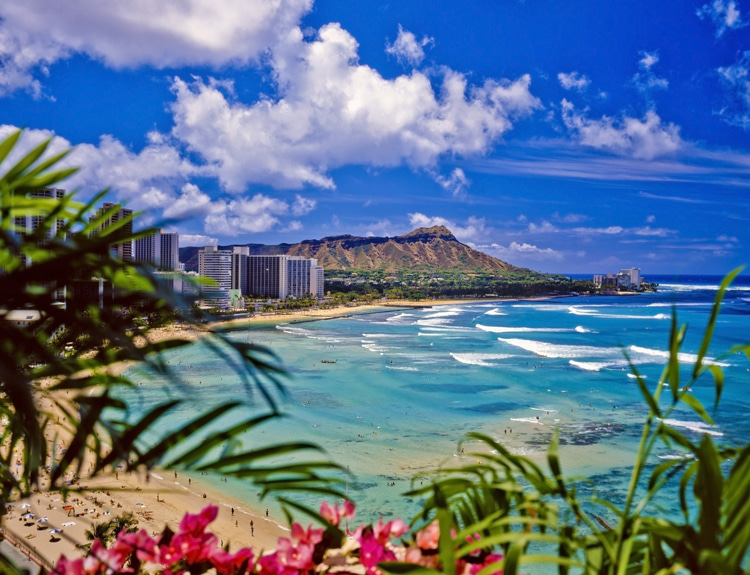
To maintain the tropical fantasy, millions of tons of sand have been systematically shipped, pumped, and imported into Waikiki from other parts of Hawaii (and even from California, such as Manhattan Beach) for over a century.
Waikiki used to be wetlands and taro fields
Before it became a world-famous beach district, much of Waikiki was marshland, fishponds, streams, and taro cultivation.
The surf breaks remained, but the landscape behind them would be almost unrecognizable to today’s visitors.
Duke’s statue is a modern surf pilgrimage site
The famous bronze statue of Duke Kahanamoku at Waikiki Beach is often draped with flower leis.
Surfers from around the world stop there as a kind of pilgrimage, paying respects to the man many consider the father of modern surfing.